Questions to Ask Yourself While Reading Scripture
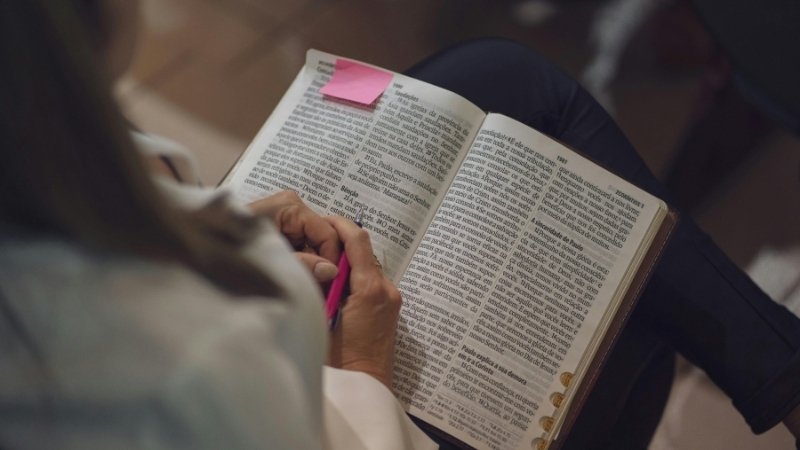
Reading the Bible is not meant to be a passive activity. You can move your eyes across every word on a page and walk away unchanged. What transforms us is not the act of reading alone, but the act of engaging—of bringing our minds, our hearts, and our questions to the text.
Throughout Scripture, we see God's people asking questions. The psalmist asks, "How can a young man keep his way pure?" (Psalm 119:9). Mary asks the angel, "How will this be?" (Luke 1:34). The disciples ask Jesus, "Explain to us the parable." God is not troubled by our questions. He invites them. The right questions open the Word to us; they turn a passage from something we observe into something we receive.
If you have ever finished a chapter and realized you cannot remember what you just read, the problem is usually not your memory. It is your engagement. The following questions will help you slow down, pay attention, and actually hear what God is saying through His Word.
Question 1: What Does This Passage Reveal About God?
Every passage of Scripture tells us something about God—His character, His actions, His promises, His holiness, His mercy. Before you ask what a passage means for you, ask what it reveals about Him. He is the main character of the Bible, not us.
When you read the creation account, you see His power and order. When you read the Exodus, you see His faithfulness to rescue. When you read the Gospels, you see His love made flesh in Jesus. When you read Revelation, you see His sovereignty over history. Training yourself to look for God first keeps Scripture from becoming a mirror in which we only see ourselves.
This single question will reshape your reading. You will start to notice attributes of God you had skimmed past for years. You will begin to worship as you read, not just study. And the more clearly you see who God is, the more everything else in your life falls into its proper place.
Question 2: What Does This Passage Reveal About Human Beings?
After looking upward, look in the mirror. Scripture is honest about humanity—our dignity as image-bearers of God, and our brokenness as sinners. It shows us people who trust God and people who run from Him, often the same people in the same story.
When you read about Israel's grumbling in the wilderness, ask where you grumble against God's provision. When you read about Peter's denial, ask where fear has made you deny what you believe. When you read about the generosity of the early church, ask where you are holding back. The Bible is not a collection of heroes to admire from a distance. It is a living mirror that exposes our hearts and invites us to change.
Hebrews 4:12 says that "the word of God is living and active, sharper than any two-edged sword, piercing to the division of soul and of spirit." That piercing work happens when we let the text search us. Asking what a passage reveals about people—about us—opens the door for that work.
Question 3: What Is the Context of What I Am Reading?
A passage read out of context can be made to say almost anything. Taking a few moments to understand context is one of the most important habits you can build. Ask: Who wrote this? Who was it written to? What comes just before and just after? Where does it fit in the larger story of Scripture?
A promise spoken to a specific person at a specific moment may not be a blanket promise to every reader. A command given to ancient Israel may be fulfilled in Christ rather than directly applied today. Understanding context does not make the Bible less relevant—it makes your application far more accurate and far more life-giving.
If you are new to thinking about context, you do not need a seminary degree to begin. Simply read the verses around your passage. Notice the connecting words like "therefore" and "but." Ask who is speaking and who is listening. For a fuller foundation, our guide on how to study the Bible for beginners walks through the basics in a practical way.
Question 4: Is There a Promise to Believe, a Command to Obey, or a Warning to Heed?
This question helps you move from observation to response. As you read, look for these three things:
- A promise to believe — something God commits to do or be, that you can rest your faith on.
- A command to obey — an instruction that calls for a change in your thinking or behavior.
- A warning to heed — a caution that protects you from a real danger.
Not every passage contains all three, but most contain at least one. Naming what you find gives your reading a clear direction. Instead of closing your Bible with a vague sense that it was "good," you walk away with something specific to trust, something specific to do, and something specific to avoid.
This is also where reading becomes personal without becoming self-centered. You are not inventing meaning; you are responding to meaning God has already placed in the text. The promise, command, or warning was there before you arrived. Your job is simply to receive it.
Question 5: How Does This Point to Jesus?
Jesus Himself taught that all of Scripture points to Him. After His resurrection, He walked with two disciples on the road to Emmaus and, as Luke 24:27 records, "beginning with Moses and all the Prophets, he interpreted to them in all the Scriptures the things concerning himself."
You do not need to force every verse into a picture of Jesus. But it is worth asking how each passage fits into the larger story that leads to Him. The Old Testament sacrificial system points forward to His once-for-all sacrifice. The kings of Israel point forward to the perfect King. The prophets' promises point forward to His coming.
When you start to see how the whole Bible holds together around Christ, your reading deepens dramatically. Individual passages stop feeling like scattered fragments and start feeling like parts of one grand, coherent story of redemption. That perspective is one of the greatest gifts you can give your Bible reading.
Question 6: What Does This Call Me to Do Today?
James 1:22 gives a sharp warning: "But be doers of the word, and not hearers only, deceiving yourselves." It is possible to read the Bible faithfully and still be self-deceived—if we never let what we read change how we live. This question turns reading into obedience.
Be specific. Vague resolutions like "I will be a better person" rarely produce change. Instead, let the passage name a concrete step. If you read about forgiveness, is there someone you need to forgive today? If you read about generosity, is there a need you can meet? If you read about prayer, when will you pray this week?
If you want to go deeper into turning reading into everyday action, our article on how to apply today's Bible reading to everyday life offers practical guidance for bridging the gap between the page and your life.
Question 7: What Do I Need to Remember From This Passage?
We forget far more than we retain. A passage that moved you on Monday can be forgotten by Wednesday. Asking what you need to remember—and then taking a small step to hold onto it—protects the seed of the Word so it can grow rather than be snatched away.
You might write down one verse that stood out. You might restate the main idea in your own words. You might pray the passage back to God, asking Him to plant it in your heart. None of these need to be elaborate. The goal is not to build an impressive notebook, but to keep the Word with you beyond the moment you read it.
For more on this, our guide on how to remember what you read in the Bible explores simple, proven practices for retaining Scripture so it shapes you over time.
A Simple Way to Use These Questions
You do not need to ask all seven questions every time you read. That would turn a quiet devotion into a stressful assignment. Instead, choose one or two questions for a given reading, and let them guide your reflection. Over a week, you will naturally work through all of them.
Some readers find it helpful to keep these questions written inside the cover of their Bible or saved in a notes app. Having them close at hand means you can turn to them whenever a passage feels confusing, dry, or distant. The right question, asked at the right moment, can turn a frustrating reading into a meaningful encounter with God.
Questions Are a Form of Humility
There is a deeper reason these questions matter. Asking them is an act of humility. It says, "I do not already know everything this passage has for me. I am willing to be surprised, corrected, and changed." That posture is exactly what God honors. Isaiah 66:2 says, "But this is the one to whom I will look: he who is humble and contrite in spirit and trembles at my word."
Come to your Bible with questions, and you will leave with answers. Come with a closed mind, and even the richest passage will pass you by. The Word of God is living, and it meets the living attention of a reader who is willing to ask, to listen, and to respond.
Open my eyes, that I may behold wondrous things out of your law. — Psalm 119:18
Ready to take the next step?
Create a free account to track your daily progress, then begin or continue the Bible In 1 Year Reading Plan.